By Ean Krenzin-Blank, CTO, SOS Technologies


Campus security conversations often start with speed. How fast can an alert get to the right people? How fast can first responders see what is happening?

Those are important questions, and SOS Live 2.0 was built around them – delivering alerts in under 5 seconds. But there is another kind of speed that matters just as much: how quickly can a real site be protected in the first place?

SOS Live 2.0 being named a 2026 Secure Campus Award winner in the Unified/Integrated Systems category is meaningful because it reflects how we’ve approached this problem from the beginning. The goal was never to build another isolated alert product. The goal was to build the engines that allow many different systems to work together quickly enough to matter.

True Integration Happens Behind the Scenes

When we talk about integrated systems, we are not just talking about a dashboard that simply claims to connect to everything. We’re talking about the engineering underneath: routing engines that can interpret outside payloads, rules that can resolve an organization or device from vendor-specific fields, and handlers for systems like a LoRa mesh, (ancient) alarm panels, camera streams, routers, Computer-Aided-Dispatch, and webhooks. Not to mention the work of mapping IDs, alarms, zones, triggers, gateway health, message formats, and location context into one response workflow.

Build on What Already Works

Most campuses are not blank slates. They already have alarm panels, receivers, cameras, PA systems, cellular routers, radios, and wireless devices in place. If the answer is always to rip everything out and start over, we slow the mission down.

A school, hospital, or corporate campus does not become safer because a new system is theoretically elegant. It becomes safer when the systems already on the walls, in the closets, on the network, and in the hands of staff can all work together as part of a coordinated response.

Engineering for Real-World Environments

That thinking has shaped the way we’ve built SOS Live 2.0. We developed gateway software to bridge local hardware through MQTT and AWS IoT. We built packages, firmware, provisioning, and multi-device flashing/configuration because installation needs to be

repeatable in the field. We kept fallbacks for legacy identifiers and older data shapes because migrations happen at customer sites, not in clean diagrams. And we moved integrations toward config-driven routing so new sources can be onboarded without rewriting the core system every time.

Reducing Complexity Before It Matters Most

That is the real value behind the Unified/Integrated Systems recognition. SOS Live 2.0 is not just fast after an alert is triggered. It is designed to reduce the friction before that moment: fewer custom installs, fewer manual handoffs, fewer one-off bridges, and less dependence on replacing existing infrastructure before a customer can benefit.

In an emergency, seconds matter. But during deployment, days and weeks matter too.

If we can support the hardware a site already owns, connect it seamlessly, and bring everything into a common operating picture, we can help make that site safer faster. That is the standard I care about.

Awards are always appreciated, but they’re most meaningful when they recognize a direction we genuinely believe in: integrated systems should not create more complexity. They should make life-safety technology easier to deploy, easier to operate, and ultimately more effective for the people who depend on and must act when something goes wrong.
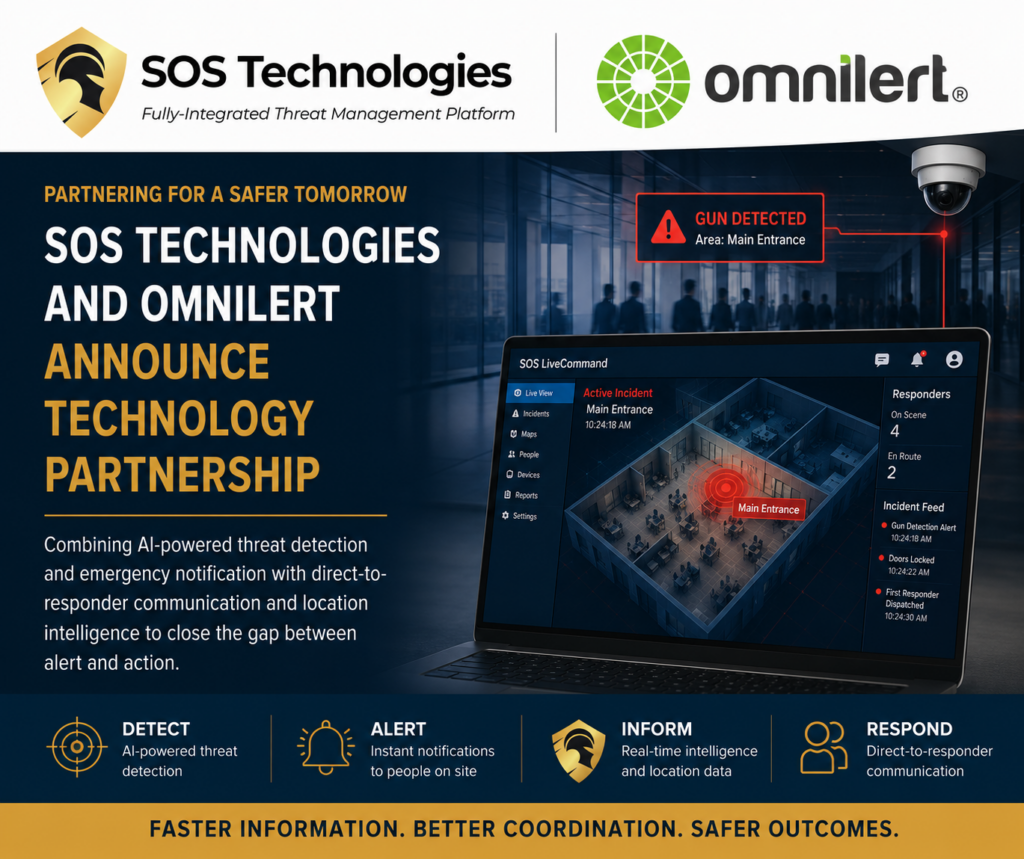

Proud to announce a new technology partnership between SOS Technologies and Omnilert.

By connecting Omnilert’s AI-powered gun detection and emergency notification capabilities with SOS LIVE 2.0, we are creating a more complete workflow from threat detection to coordinated response. The goal is simple: get verified incident information, real-time location intelligence, and actionable context to responders faster, when every second matters.

Read the announcement: https://apnews.com/press-release/pr-newswire/press-release-055e2c82aef72f781a8d617659fbc43f

#PublicSafety #EmergencyResponse #AI #SecurityTechnology


Partnership expands access to SOS Live emergency response solutions through Compulink’s public sector, education, healthcare and enterprise customer base.

NEW YORK and DEERFIELD BEACH, Fla.July 7, 2026 /PRNewswire/ — SOS Technologies and Compulink Technologies today announced a strategic partnership to expand access to SOS Technologies’ SOS Live emergency response platform for public sector, education, healthcare, nonprofit, and enterprise organizations.

Through the partnership, Compulink Technologies will serve as an authorized reseller of SOS Technologies’ solutions, helping customers evaluate, procure, and deploy modern emergency response technology designed to improve situational awareness, accelerate response times, and reduce delays between an incident and responder action.

SOS Live helps organizations close the emergency response gap by connecting people, facilities, and first responders through a secure cloud-based platform. The platform provides panic alerting, precise indoor location services, emergency communications, device monitoring, video and system integrations, and direct responder workflows within a single operating environment.

Compulink Technologies brings extensive experience in public sector technology, IT procurement, professional services, hardware and software fulfillment, managed services, and implementation support. Compulink is also available through OMNIA Partners, enabling eligible public agencies, education institutions, healthcare organizations, and nonprofit entities to access technology solutions through established cooperative purchasing channels.

“Compulink gives SOS Technologies a strong strategic partner with the customer relationships, procurement expertise, and implementation capabilities needed to help organizations move from evaluation to deployment,” said Travis Leonardi, CEO of SOS Technologies. “Emergency response technology must be secure, practical to deploy, and easy to procure. This partnership expands our ability to bring SOS Live to more schools, healthcare facilities, public agencies, nonprofits, and enterprises that need faster, more coordinated emergency response.”

SOS Technologies is GovRAMP Authorized, providing customers with additional confidence that the SOS Live platform has been independently reviewed against rigorous security requirements for state and local government cloud environments. This designation is particularly important for public sector, education, healthcare, nonprofit, and enterprise customers evaluating emergency response platforms that must meet high standards for security, reliability, and operational readiness.

As part of the partnership, Compulink Technologies will help customers evaluate, purchase, and deploy SOS Technologies’ solutions across a broad range of environments, including K-12 schools, higher education campuses, healthcare facilities, municipal buildings, commercial properties, nonprofit organizations, and other locations where rapid emergency response is critical.

“Compulink is committed to delivering technology solutions that are secure, scalable, and operationally impactful,” said Denise Arboleda, VP Sales at Compulink. “SOS Technologies addresses a critical need by helping organizations improve how they communicate, coordinate, and respond during emergencies. We are excited to bring SOS Live to our customers through our reseller model and established public sector procurement channels.”

Together, SOS Technologies and Compulink Technologies will provide organizations with a streamlined path to adopting SOS Live while leveraging Compulink’s technology services, implementation expertise, and procurement capabilities. The companies will work closely with customers seeking to strengthen emergency preparedness, improve safety operations, and provide responders with better information when seconds matter. For more information Visit: www.sos-tech.com or www.compu-link.com 

About SOS Technologies

SOS Technologies provides a real-time emergency response platform designed to reduce delays, improve situational awareness, and help first responders act faster. The SOS Live platform connects panic alerts, precise location, emergency communications, system integrations, video intelligence, and responder workflows into a secure operating environment. SOS Technologies serves organizations across education, healthcare, public sector, retail, commercial real estate, and other high-risk environments where seconds matter.

SOS Technologies is GovRAMP Authorized, reinforcing the company’s commitment to security, compliance, and trusted cloud operations for organizations with mission-critical safety requirements.

About Compulink Technologies

Compulink Technologies is a full-service IT solutions provider serving public sector, education, healthcare, nonprofit, and enterprise customers. The company provides hardware, software, professional services, tailored staffing, managed services, cloud services, cybersecurity services, networking, application delivery, IT service management, storage, and other technology solutions. Compulink supports public agencies and organizations across the United States and is available through OMNIA Partners for eligible cooperative purchasing customers.

MEDIA CONTACT:

SOS Technologies 
Jonathan Fischer
Chief Revenue Officer
PR@sos-tech.com 
1-800-722-7601
www.sos-tech.com


Compulink Technologies
Danielle Arboleda
Director of Operations
darboleda@compu-link.com 
1-215-695-5465 (Ext. 16)
www.compu-link.com 


By Tony Bouvia, VP Sales, SOS Technologies

A Name We Should Never Forget and a Mission We Cannot Ignore

As a father and grandfather, school safety is not an abstract policy discussion for me. I have a granddaughter in school today, with younger grandchildren who will follow. Like every parent and grandparent, I want to believe that when we send them through those doors, the people responsible for their safety have every possible tool available to protect them. 

That is why Alyssa’s Law, what it stands for, and the protection it is fighting to provide, means so much to me. 

More Than the Name of a Law

Alyssa’s Law honors Alyssa Alhadeff, who was only 14 when she was killed in the February 14, 2018, shooting at Marjory Stoneman Douglas High School in Parkland, Florida. 

Alyssa was an honor student, a winning debater, a competitive soccer player and team captain, a friend, a big sister, and a deeply loved daughter. She had plans and an entire life ahead of her. She should still be here. 

Her parents, Lori and Ilan Alhadeff, turned unimaginable grief into action by creating Make Our Schools Safe (MOSS) and fighting for practical changes that can protect other children. Every state that passes Alyssa’s Law carries her name forward through action, not simply remembrance. 

Why the Law Matters

Although requirements vary by state, Alyssa’s Law generally calls for silent panic alert technology that can instantly connect schools with law enforcement or emergency responders during a life-threatening event. Its significance is simple: it saves time. 

During an emergency, teachers should have a simple and immediate way to call for help. They should not have to jump through hoops, navigate complex keystrokes, or make a phone call while trying to protect their students. One simple action should notify responders and provide the location and intelligence they need to act quickly. 

When help is needed, seconds are a precious commodityThey can make a difference for a child, a teacher, a first responder, or any family waiting for someone they love to come home.  

Where Alyssa’s Law Stands

As of June 2026, Make Our Schools Safe identifies 12 states that have passed Alyssa’s Law or a recognized state version: New Jersey, Florida, New York, Texas, Tennessee, Utah, Oklahoma, Georgia, Washington, Oregon, Virginia, and West Virginia. 

Another 14 states have legislation introduced or in progress: Alabama, Arizona, Arkansas, Illinois, Kentucky, Maine, Massachusetts, Michigan, Mississippi, Missouri, Nebraska, Ohio, Pennsylvania, and South Carolina. Connecticut has also made panic alarms and emergency response systems eligible for school security grant funding, although that step is not yet Alyssa’s Law. 

Passing the Law Is the Beginning

The button itself is not the outcome. The outcome is a verified alert reaching the right responders in seconds, with precise location and useful information. Schools also need reliable technology, tested workflows, training, system monitoring, and redundant communication paths. 

At SOS Technologies, our mission is centered on creating a more direct and rapid connection to help. That matters to me professionally, but it is personal long before it is professional. When I think about school safety, I think about my grandchildren, their teachers and every family trusting that help will be notified immediately if the unthinkable happens. 

Alyssa should still be here. We cannot change that heartbreaking truth. But we can honor her by acting with urgency, protecting the children who enter our schools every day and remembering that, in an emergency, time is not a detail. 

                                                      Time is life.

By Tony Bouvia, VP Sales, SOS Technologies

Differentiate Your Business. Create New Revenue. Deliver Greater Value.

I have spent almost 27 years working with and for partners and solution providers across a wide range of markets.

That includes time with Cisco, Cradlepoint before and after its acquisition by Ericsson, and an IT reseller. I’ve had the chance to see the channel from both sides—the technology manufacturer and the solution provider.

A lot has changed during that time.

Technology has evolved in ways that even the most visionary technology believers 20 years ago probably could not have imagined. But one challenge has stayed the same:

How do you stand out when customers and partners themselves are overwhelmed by more products, more vendors, and more services than ever before?

The answer is simple, but it is not always easy:

Focus on outcomes.

That is exactly what we are working to do at SOS Technologies as we continue building our partner program.

We work closely with our partners to help them stand out, create new recurring revenue, and deliver real safety and operational value to their customers.

Because customers do not need another product just for the sake of having another product.

They need a trusted partner who can help solve real problems, improve response, and create safer environments for employees, customers, students, patients, and communities.

According to the U.S. Bureau of Labor Statistics, more than 57,000 nonfatal workplace violence cases over a recent two-year period resulted in days away from work, job restrictions, or transfers.

That number is a reminder that organizations need to keep improving how they protect their people, prepare for emergencies, and respond when something happens.

This Mission Is Personal to Me

My daughter is a nurse.

My 8-year-old granddaughter goes to school every day, and my 4-year-old and 2-year-old granddaughters—and now my newborn grandson—are not far behind her.

So, when we talk about workplace safety, school safety, faster response, and getting the right help to the right place when seconds matter, I don’t see it as just another technology discussion.

I think about my daughter walking into a hospital every day to take care of other people.

I think about my granddaughter walking into school to learn, grow, and simply be a kid.

I think about my younger grandchildren and the schools, workplaces, and public spaces they will enter in the years ahead.

That is why the SOS mission means so much to me.

Yes, we help partners differentiate their businesses, create recurring revenue, and bring more value to their customers. But we also give them the opportunity to offer something that can make a real difference for the people inside those organizations.

That combination of business value and human impact is what makes this opportunity different.

Growing Demand Across the Market

Organizations across education, healthcare, retail, government, and enterprises are under more pressure to improve safety and emergency response.

Legislation and initiatives such as Alyssa’s Law, the New York Retail Worker Safety Act, Florida’s postsecondary school safety requirements, and emerging healthcare worker safety measures are creating new demand for solutions that go beyond traditional panic buttons and mass notification systems.

Customers are looking for better ways to move from simply sending an alert to getting the right information to the right people and helping them respond faster.

That is where SOS can make a difference.

More Than Traditional Security

Many partners already sell networking, physical security, access control, video surveillance, cloud, communications, or managed services.

SOS fits alongside those solutions.

Our platform helps organizations improve situational awareness, speed up emergency response, and coordinate action when time matters most.

That gives partners the opportunity to have a different kind of conversation with their customers.

Instead of only talking about products and features, they can talk about:

  • Improving employee and customer safety
  • Strengthening emergency preparedness
  • Reducing the impact of workplace violence
  • Increasing duty of care
  • Supporting compliance requirements
  • Improving operational resiliency
  • Getting the right help to the right place faster

Those are conversations that matter to executives and create opportunities that many competitors are not prepared to address.

New Recurring Revenue Opportunities

SOS can also create several new revenue opportunities for partners, including:

  • Annual software subscriptions
  • Recurring platform revenue
  • Professional services
  • Deployment and implementation services
  • Managed service offerings
  • Expansion opportunities within existing accounts

This is not just a one-time product sale.

It gives partners the chance to build longer-term customer relationships with ongoing revenue, continued engagement, and room to grow.

Expand the Relationships You Already Have

One of the biggest advantages of partnering with SOS is that you can bring a new, strategic solution into accounts you already know.

SOS can complement and integrate with technologies customers may already use, including:

  • Video surveillance
  • Access control
  • AI analytics
  • Communications platforms
  • Public safety solutions

That creates opportunities to go deeper within existing accounts, expand wallet share, and strengthen your position as a trusted advisor.

A question we hear often is:

“How do we get the right help to the right place faster?”

SOS helps our partners answer that question.

A Partner-First Approach

Whether you are a reseller, integrator, technology partner, carrier, MSP, or referral partner, our goal is to help you succeed.

We support our partners with:

  • Sales and technical enablement
  • Joint go-to-market planning
  • Co-selling opportunities
  • Training and ongoing support
  • Flexible ways to engage

We want to help partners grow their businesses while delivering better outcomes for their customers.

The Bottom Line

Partnering with SOS Technologies helps you:

Differentiate your portfolio

Create new recurring revenue streams

Expand existing customer relationships

Access emerging market opportunities

Deliver meaningful safety and business outcomes

Participate in a mission that helps protect people when seconds matter

Join the Mission

The future belongs to partners who move beyond products and focus on outcomes.

At SOS Technologies, that means creating business value while helping organizations get the right help to the right place faster when every second matters.

For me, this mission is personal because I think about my daughter, my grandchildren, and the environments they enter every day. But this is bigger than any one family. It is about helping protect nurses, teachers, students, employees, customers, first responders, and communities everywhere.

If you are looking to differentiate your business, create new recurring revenue opportunities, and deliver solutions with meaningful human impact, I invite you to contact me and learn more about becoming an SOS Technologies partner.

Join us in building a future where faster response and safer outcomes are available to everyone when help is needed most.

Safety Systems Must Be Built for Interoperability

By Jonathan Fischer

Emergency response has changed.

For years, organizations have implemented safety tools one system at a time: panic buttons, cameras, access control, mass notification platforms, building systems, dispatch workflows, and communication platforms. Each solution may address a specific operational need, but emergencies rarely happen in isolation.

When an incident occurs, teams do not have time to move between disconnected systems, verify information manually, relay updates through phone calls, or coordinate response efforts across separate platforms.

Every second matters, and delays can directly impact response effectiveness.

That is why interoperability is no longer just a technical feature. It has become an operational requirement for modern emergency response.

Why Connected Safety Infrastructure Matters Now

Disconnected Systems Create Gaps and Slow Emergency Response

Most organizations already have strong safety infrastructure in place. The challenge is that many of these systems operate independently.

Security may own cameras. Facilities may oversee access control. The IT department may handle networks and communication systems. Operations may coordinate internal procedures, while public safety partners rely on separate dispatch platforms.

Individually, these systems provide value. During an emergency, however, disconnected systems can create operational gaps that slow response coordination.

Teams need immediate answers to critical questions:

  • Where is the incident happening?
  • Who activated the alert?
  • Is the threat moving?
  • Have responders been notified?
  • Are occupants inside the building receiving instructions?
  • Can doors be locked or emergency systems be activated?
  • Is accurate information reaching dispatch and first responders?

When systems are fragmented, each of these tasks often requires manual effort:

  • Verifying alerts
  • Reviewing video feeds
  • Contacting internal teams
  • Notifying dispatch
  • Activating building systems
  • Continuously sharing updates as conditions evolve

That process creates unnecessary delays, increases confusion, and introduces additional operational risk during high-pressure situations.

What True Interoperability Should Deliver

Interoperability is not simply connecting software through an API. True interoperability means that communication, data, and response workflows move together in real time.

For example, panic buttons should do more than generate a basic alert. A connected system should be capable of:

  • Identifying the device or individual
  • Providing precise location information
  • Displaying relevant camera feeds
  • Notifying the right personnel
  • Activating visual or audible alerts
  • Delivering actionable information directly to dispatch or first responders

Similarly, cameras should do more than record footage after an event occurs. They should help responders understand what is happening in real time.

Building systems should also play an active role in emergency response by supporting lockdown procedures, access control changes, or other automated actions when appropriate.

Communication platforms should not operate separately from the response process. They should help ensure that the right people receive the right information at the right time.

The goal is not to create additional complexity. It is to improve coordination, situational awareness, and response execution during critical incidents.

How Interoperability Improves Response Coordination

When safety systems work together, organizations can respond more effectively.

Response teams gain access to shared incident data, allowing security, operations, facilities, leadership, and public safety personnel to coordinate from a common operating picture.

Alerts can be tied to buildings, floors, rooms, zones, or specific devices, improving situational awareness and helping responders make faster decisions.

This matters because emergency response is not only about sending notifications. It is about enabling informed action.

A faster alert is valuable. A faster and better-informed response is what improves outcomes.

Interoperability helps organizations:

  • Reduce communication delays
  • Improve coordination between teams
  • Strengthen situational awareness
  • Support faster decision-making
  • Minimize operational disruption during emergencies

In high-stress environments, clarity matters. Connected systems help organizations move from basic awareness to coordinated response.

Improving Safety Without Replacing Existing Infrastructure

Interoperability does not require organizations to replace their existing technology investments.

Most organizations have already invested heavily in cameras, access control systems, radios, notification platforms, building systems, networks, and emergency procedures. Those investments are still valuable.

The better approach is to connect existing systems into a broader response architecture that improves how they work together during an incident.

This flexibility is critical because every organization operates differently. Hospitals, school districts, corporate campuses, retail environments, and public facilities all have unique infrastructure, budgets, operational requirements, and response protocols.

An interoperable approach allows organizations to build on what they already have while improving coordination across systems, teams, and emergency workflows.

Building for the Next Generation of Threats

Safety technology cannot be built only for today’s checklist. It must be flexible enough to support future operational challenges.

Threats will continue to evolve. Organizations will add new facilities, technologies, communication channels, and operational partners. Regulations and compliance requirements will also continue to change.

A safety platform that cannot adapt will eventually become another silo.

Modern safety architecture should support integration with:

  • Public safety systems
  • Enterprise communication platforms
  • Building infrastructure
  • Real-time location intelligence
  • New sensors
  • Emerging technologies such as computer vision and AI-driven analytics

Organizations may not be able to predict every emergency scenario, but they can build a stronger operational foundation for response.

The Future of Emergency Response Is Connected

In the moments that matter most, disconnected systems create delays.

Connected systems create clarity.

And clarity saves time and lives.

As emergency response environments become more complex, interoperability is no longer optional. It is becoming the foundation of modern safety operations.

Organizations that prioritize connected safety infrastructure today will be better positioned to adapt, coordinate, and respond to the challenges of tomorrow.

The New York Retail Worker Safety Act

By Tony Bouvia, VP of Sales

The next retail safety incident will not wait for your policy to be finalized, for training to be completed, or for someone to decide what to do.

When something happens, it happens fast. Your response needs to be faster.  As a New York resident, I live, work, and shop here with my wife, children, and grandchildren. Retail safety isn’t just a business conversation for me—it’s deeply personal.

The only question that matters is this: Does your team know what to do, and do you have systems in place that support their safety?

What It Requires and Why Compliance Alone Is Not Enough

Retail Worker Safety Is Now a Business-Critical Issue

Retail environments have changed. Workplace violence, organized retail crime, and employee safety incidents are rising, and they are no longer rare or unpredictable. They are showing up in everyday operations.

According to the National Retail Federation, over 80% of retailers report increased violence and aggression against employees in recent years.

This is not just a security concern. It is a business risk.

When safety is not addressed: employees leave, store operations are disrupted, risk and liability increase and brand trust erodes.

What was once managed reactively now demands a structured, proactive approach.

Understanding the New York Retail Worker Safety Act

The New York Retail Worker Safety Act reflects the reality retailers are already facing.

As workplace violence and organized retail crime rise, the law shifts the focus from traditional loss prevention to employee safety.

Passed in 2024 and amended in 2025, the law took effect on June 2, 2025, with initial requirements focused on policy development and employee training. More mandates, such as silent panic buttons for larger employers, will be implemented in phases through January 2027.

The requirements are straightforward, but their impact is significant.

Organizations with ten retail employees must implement a workplace violence prevention policy and provide annual training. Organizations with 500 or more employees must also deploy silent panic buttons.

Full compliance is expected by January 2027.

What Compliance Looks Like in Practice

On paper, compliance is simple. In practice, it is where most organizations fall short.

Policies do not guide action at that moment. Training does not remove confusion under pressure. And the panic button alone does not ensure an effective emergency response.

What matters is what is happening when an incident begins. Things like how quickly an alert is triggered, who receives it, and whether the information is clear and actionable.

In real situations, delays and uncertainty create seconds of unnecessary risk. When seconds matter, a coordinated response determines the outcome.

How SOS Technologies Delivers More Than Compliance

Effective emergency response depends on alerts, communication, and action working seamlessly in real time. This is where traditional approaches break down.

SOS Technologies closes the gap between compliance and real-world response with:

  • Silent activation
  • Verified real-time data
  • Precise location intelligence
  • Direct coordination with first responders

The system moves beyond simple notification to enable immediate, informed action.

That critical distinction matters.

Because in an emergency, awareness without coordination is not enough.

Getting Ahead of the 2027 Deadline

January 2027 may seem distant. It is not.

For organizations with multiple locations, implementation takes time—evaluating systems, aligning teams, deploying at scale, and ensuring performance under pressure.

Waiting only increases risk.

Retailers that act now will not just meet compliance requirements without disruption; they will operate with confidence, control, and preparedness.

The time to prepare is not later; it is now, before the moment comes when it matters most.

By: Jonathan Fischer, Chief Revenue Officer

Emergencies in high-stress environments escalate quickly and without warning. Critical decisions need to be made in seconds, not minutes.

That is not a theory. I lived it.

As a firefighter, most of our calls were what you would expect: building fires, serious car accidents, HazMat incidents. You train, show up, and execute.

But one call changed how I viewed emergency response.

I was assigned to a Rapid Intervention Team (RIT), the unit responsible for rescuing firefighters if something goes wrong inside a fire. We were called to assist with a fire at a motorcycle shop in a neighboring city.

When we arrived, it felt routine. RIT teams stage outside, gear up, and hope they are never needed. We had just stepped off the truck and started putting on our air packs.

Then a civilian ran toward us screaming: “The building collapsed.”

That was the first time we heard this…

The Reality of Emergency Response

In an instant, we went from standby to full rescue mode—but we were already behind.

We did not know where the firefighters were inside the building. Radio traffic was chaotic, split across multiple departments and frequencies.

Firefighters train for this. But we were working without context.

One firefighter was trapped in an A-frame collapse; his leg crushed under concrete. Conditions were brutal, fire overhead, freezing temperatures everywhere else, equipment failing, everything working against us.

The second firefighter did not survive. Later we would find him trapped under a large section of the roof that fell toward the road.

He was young. A great firefighter. Someone who showed up to help others—and did not make it home.  It affected everyone around us. Still one of the saddest days of my firefighter career.  

High Stress Changes Everything

According to FEMA, confusion and delayed communication are among the biggest barriers to effective incident response, especially in large complex environments.

In high stress moments, people do not behave the way procedures assume they will.

  • The information is incomplete.
  • Communication breaks down.
  • Decisions are made on fragments, not facts.

Even as a trained responder, you are not just managing the incident.

You are managing uncertainty.

And uncertainty costs time.

Why Traditional Alerts Fall Short

Most emergency alert systems are built to notify, not inform.

An alert might say: “Emergency in progress” or “Structure fire.” But that does not answer the questions that truly matter such as:

  • Where exactly is the problem?
  • Who is involved?
  • What has just changed?

Without that context, response becomes reactive instead of strategic.

In our case, the most critical update—the collapse—did not come through the system we relied on.

It came from a civilian running down the street.

That gap matters.

What Effective Response Actually Requires

The difference in effective response is not just speed; it is clarity.

  • If we had known immediately that a collapse occurred…
  • If we had precise location data of the firefighters inside…
  • If communication had been unified across teams…

Those first few minutes would have been different.

And in these situations, seconds are everything.

A Shift Toward Intelligent Response

Organizations are starting to recognize that emergency response must evolve from alert-based systems to intelligence-driven platforms.

Responders do not just need to know that something is wrong.

They need to know:

  • What is happening
  • Where it is happening
  • How it is changing in real time

That is what enables teams to move:

From guessing to acting.

From reacting to executing and executing with the best intel.

Final Thought

Emergencies will always be high stress. That will not change. What can change is how prepared we are when they happen.

Because from where I have stood, the greatest risk is not just the incident itself,

It is not knowing.

By Travis Leonardi, CEO, SOS Technologies

Emergencies can occur anywhere, not only in schools, but also in municipal buildings, corporate offices, healthcare facilities, retail environments, libraries, and transit hubs. Yet many safety systems in these environments still rely on indirect communication methods and outdated emergency alert systems, introducing unnecessary delays when help is needed most.

For years, emergency alert systems were built for internal notification first and emergency response second. So, when a panic button is pressed, the alert often notifies security personnel or administrators, and then someone must verify the situation, locate a phone, dial 9-1-1, and verbally relay information to emergency dispatch.

In today’s threat landscape, that workflow approach is no longer acceptable.

Modern public safety technology must do more than sound an alarm. It must connect directly to emergency communication centers and deliver actionable information
instantly.

This is where direct-to-911 integration is transforming emergency response. When an alert is triggered, dispatch receives immediate, accurate, and structured information without delay.

The Limitations of Traditional Alert Systems

Most legacy panic button systems rely on a manual chain of communication. In high-stress situations, confusion and incomplete information can make it difficult to accurately
describe what is happening, especially inside large buildings where pinpointing a location can be challenging.

An effective emergency response system should eliminate these barriers and not rely on manual steps when automation can instantly connect people in danger with first responders.

What Direct-to-911 and First Responders Integration Enables

Direct-to-911 and first responders’ integration removes the layers between the person in danger and emergency services. When an alert is triggered, dispatch automatically receives structured incident data, including:

  • Exact location within a building
  • Type of emergency being reported
  • Real-time incident details

Rather than spending valuable time establishing basic facts over a phone call, emergency
dispatchers receive clear, actionable intelligence that enables them to coordinate
the appropriate response immediately.

Faster Response Through Automation

Emergency response speed depends not only on how quickly an alert is triggered, but also on how efficiently it moves through the response chain.

Traditional systems require an internal recipient to interpret the alert and then place a 911 call, adding critical minutes. With direct integration, alerts automatically move from
activation to emergency dispatch and first responders in seconds.

In a large-scale deployment in New York City, SOS Technologies’ direct-to-911 Emergency Alert System drastically reduced emergency notification times from several minutes to
under 10 seconds.

That difference can be critical during medical emergencies, violent incidents, or active
threat situations.

Why Location Intelligence Matters in Emergency Situations

One of the greatest challenges in emergency response is identifying the exact source of an incident. This is especially difficult in large offices, hospitals, campuses, and public facilities with multiple floors, hundreds of rooms, and complex layouts.

A street address may identify the building; but it rarely tells responders where inside the structure the emergency is occurring.

The SOS Technologies platform provides precise indoor location intelligence, including floor-level detail, and contextual incident data. This enables law enforcement and first responders to quickly pinpoint where help is needed.

With accurate information in hand before arrival, responders can act faster, coordinate more effectively, and approach the situation better prepared.

Taking Minutes Down to Seconds

Every second matters in an emergency. According to the American Heart Association, survival rates decrease by about 7–10% for every minute without CPR or defibrillation. Even small delays in contacting emergency services can have life-altering consequences.

By eliminating delays and delivering real-time, actionable intelligence directly to 911 and first responders, direct-to-911 alert systems represent a critical advancement in public safety. They empower faster responses, better decision-making, and ultimately, more lives are saved. In emergencies, time isn’t just important; it’s everything. And the systems we choose today can make a difference between tragedy and survival tomorrow.

By Travis Leonardi, CEO, SOS Technologies

Healthcare has always been a high-pressure environment. Today, however, the safety challenges facing hospitals are escalating.

Workplace violence in healthcare is rising. According to the U.S. Bureau of Labor Statistics reports that 75% of nearly 25,000 workplace assaults reported each year occur in healthcare and social service settings. Security resources are stretched thin, and when incidents occur, delays in response can have serious consequences for both staff and patients.

If we are serious about protecting caregivers, we must acknowledge that many traditional security approaches were not designed for the realities healthcare systems face today.

The Safety Gap

Workplace violence in healthcare is not an isolated issue. The U.S. Bureau of Labor Statistics reports that health care and social service workers are five times more likely to suffer a workplace violence injury than workers overall. OSHA echoes this concern, noting that healthcare workers experience workplace violence at significantly higher rates than most other industries. Healthcare leaders confirm the trend as well, with the American Hospital Association reporting that incidents of workplace violence occur daily in many hospital emergency departments.

Nearly 41% of registered nurses report experiencing workplace violence, and 27% say those experiences have made them consider leaving the profession.

For many healthcare workers, aggressive behavior has unfortunately become an expected part of the job.

At the same time, hospitals are operating under staffing shortages and financial pressures that limit their ability to expand security teams. This creates a widening gap between the number of incidents occurring and the resources available to respond.

Healthcare environments are also uniquely complex. A single hospital campus may include emergency departments, behavioral health units, outpatient clinics, and high-traffic public areas. When an incident escalates, a response must be both immediate and precise.

The Cost of Delay

In many hospitals, the time between identifying a threat and coordinating a response can stretch eight to ten minutes.

These delays often stem from manual processes such as locating a phone, making calls, clarifying locations, and dispatching responders.

In a multi-story hospital, minutes can determine whether an incident is quickly contained or escalated further.

The financial impact is significant as well. The average cost of hospital workplace violence can exceed $61,000 per incident when turnover, absenteeism, and operational disruption are considered.

But the human cost matters more. Caregivers should never have to question their safety or whether help will arrive quickly.

The Challenge Inside the Building

Location is another major challenge.

Traditional GPS works well outdoors but struggles inside large concrete and steel structures. Hospitals are vertical, complex environments where responders must often locate a specific room, unit, or floor.

Arriving at the building is not the same as arriving in an emergency.

Healthcare leaders increasingly recognize that effective response requires precise indoor location intelligence, along with faster ways to initiate and coordinate help.

Moving Forward

Improving healthcare safety requires a combination of leadership, operational planning, and tools designed for these environments.

At SOS Technologies, we work closely with healthcare organizations to understand these challenges and help close the gap between detection and response. The goal is simple: make it easier for staff to call for help and ensure first responders have the information they need to act quickly.

Technology alone will not solve the problem. But when combined with strong leadership and thoughtful implementation, it can help hospitals respond faster and with greater confidence.

Healthcare exists to care for others. Ensuring the safety of the people who deliver that care should be a priority for every organization because protecting caregivers is not only a safety imperative; but also essential to sustaining the healthcare workforce itself.