
Emergency Response Built for Charter Schools
Faster alerts. Better information. More coordinated response.
Charter schools operate with a clear responsibility: protect students, staff, and campus communities while keeping learning environments safe, open, and prepared.
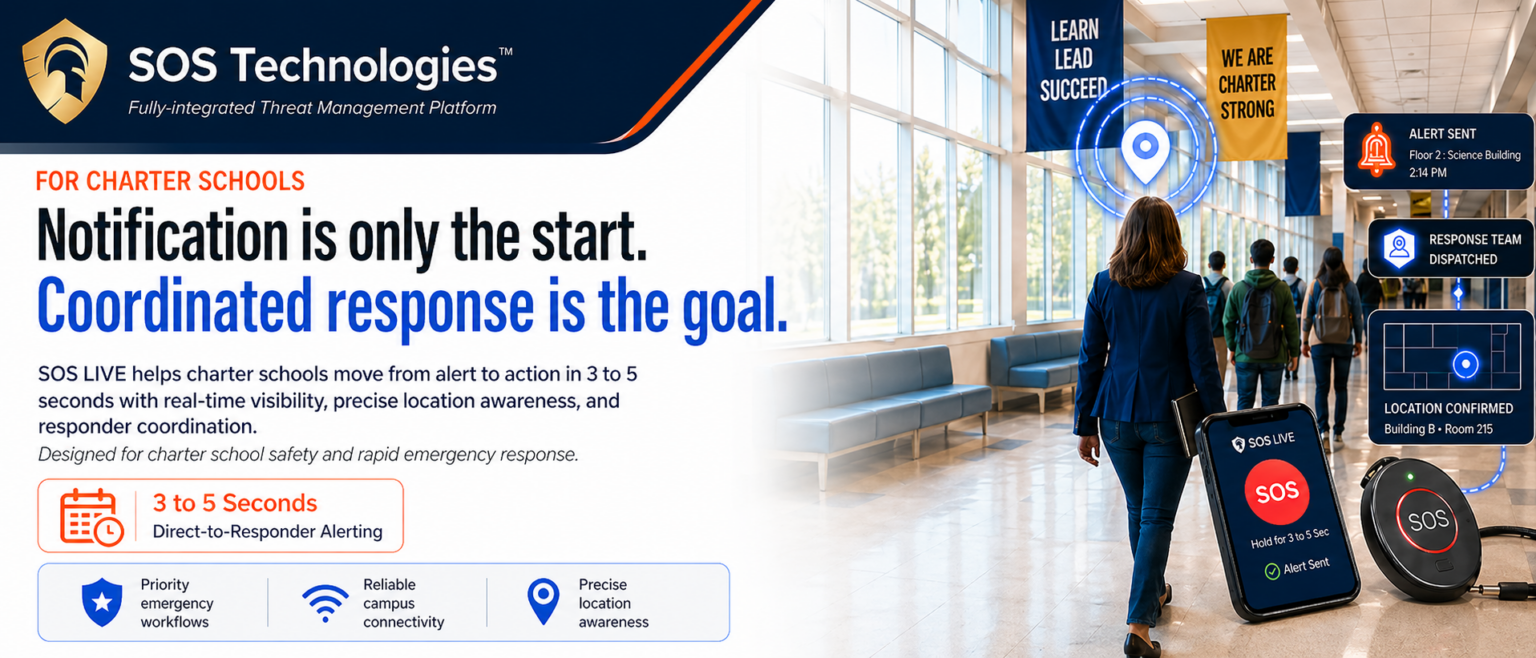
SOS Technologies helps charter schools close the emergency response gap by connecting emergency alerts directly to the right responders in seconds. Instead of relying on manual phone calls, delayed escalation, or unclear location details, SOS provides a faster, more precise way to activate help, share critical information, and support first responders when every second matters.
Why Charter Schools Need a Faster Alerting System
In a serious emergency, the first few seconds shape the entire response.
Traditional emergency workflows often depend on someone identifying the threat, calling 911, explaining the situation, confirming the location, and waiting for information to move through multiple steps before responders are fully informed. In many environments, older emergency response methods can take up to 14 to 17 minutes before the right responders have the right information.
SOS Technologies is designed to reduce that delay by notifying emergency responders in less than five seconds.
With direct emergency activation, real-time location awareness, and integration into public safety workflows, SOS helps schools move from uncertainty to action quickly.
Older emergency response methods can take up to 14 to 17 minutes when alerts depend on manual calls, escalation steps, and unclear location details.
SOS helps schools notify emergency responders quickly with critical alert context when a situation begins.
Indoor location intelligence can help identify where an alert originated inside a building.
Designed for Real School Environments
Charter schools are not one-size-fits-all. Some operate in single buildings. Others manage multiple campuses, leased facilities, shared buildings, or networks across different neighborhoods.
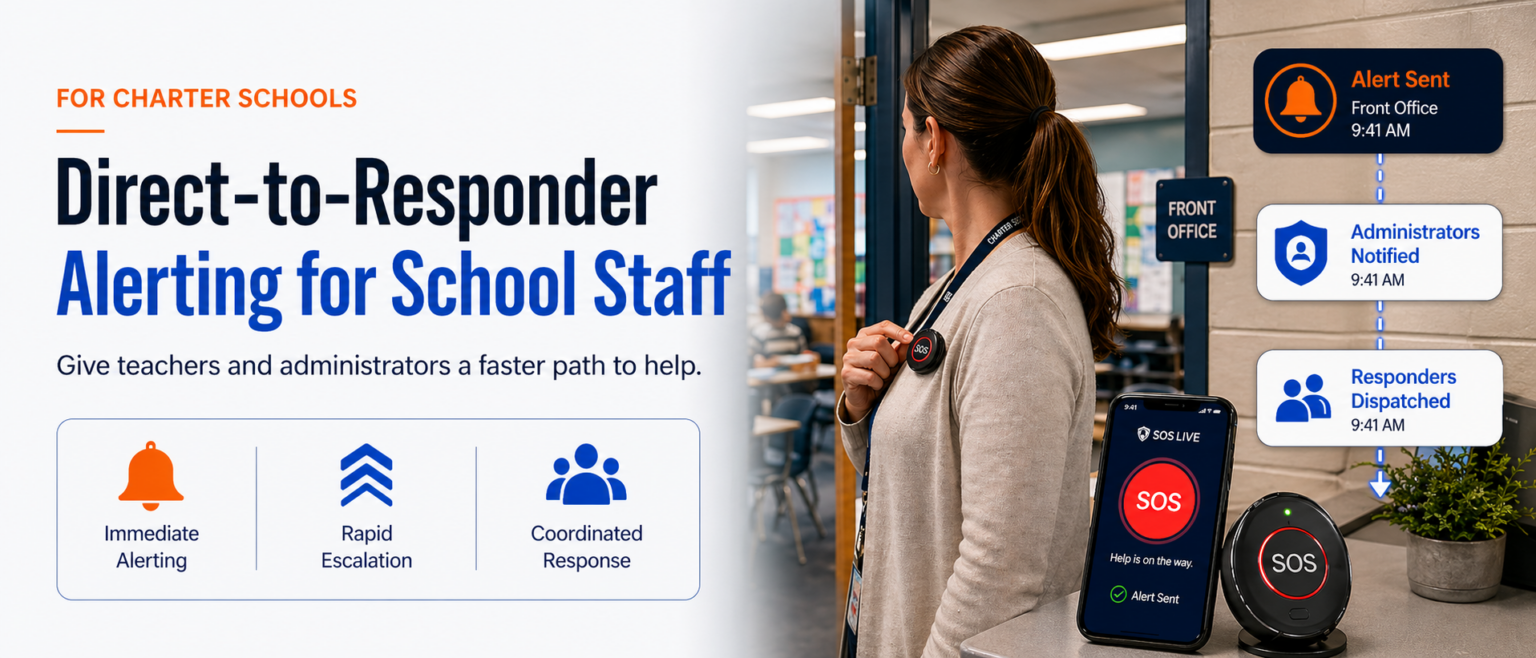
SOS is built to support those environments with flexible deployment options, including:
Staff Activation
Teacher and staff wearable alert buttons, along with wall-mounted emergency buttons in strategic locations.
Campus-Wide Alerting
Strobes and sirens for visual and audible alerts across school buildings and campus environments.
Reliable Connectivity
Live gateway connectivity with redundant network paths to help ensure alerts get out when they matter most.
Location and Visibility
Indoor location awareness and cloud-based command visibility for school leadership and safety teams.
The result is a safety platform that can grow with a charter network, whether it serves one building or dozens.
From Alert to Action in Seconds
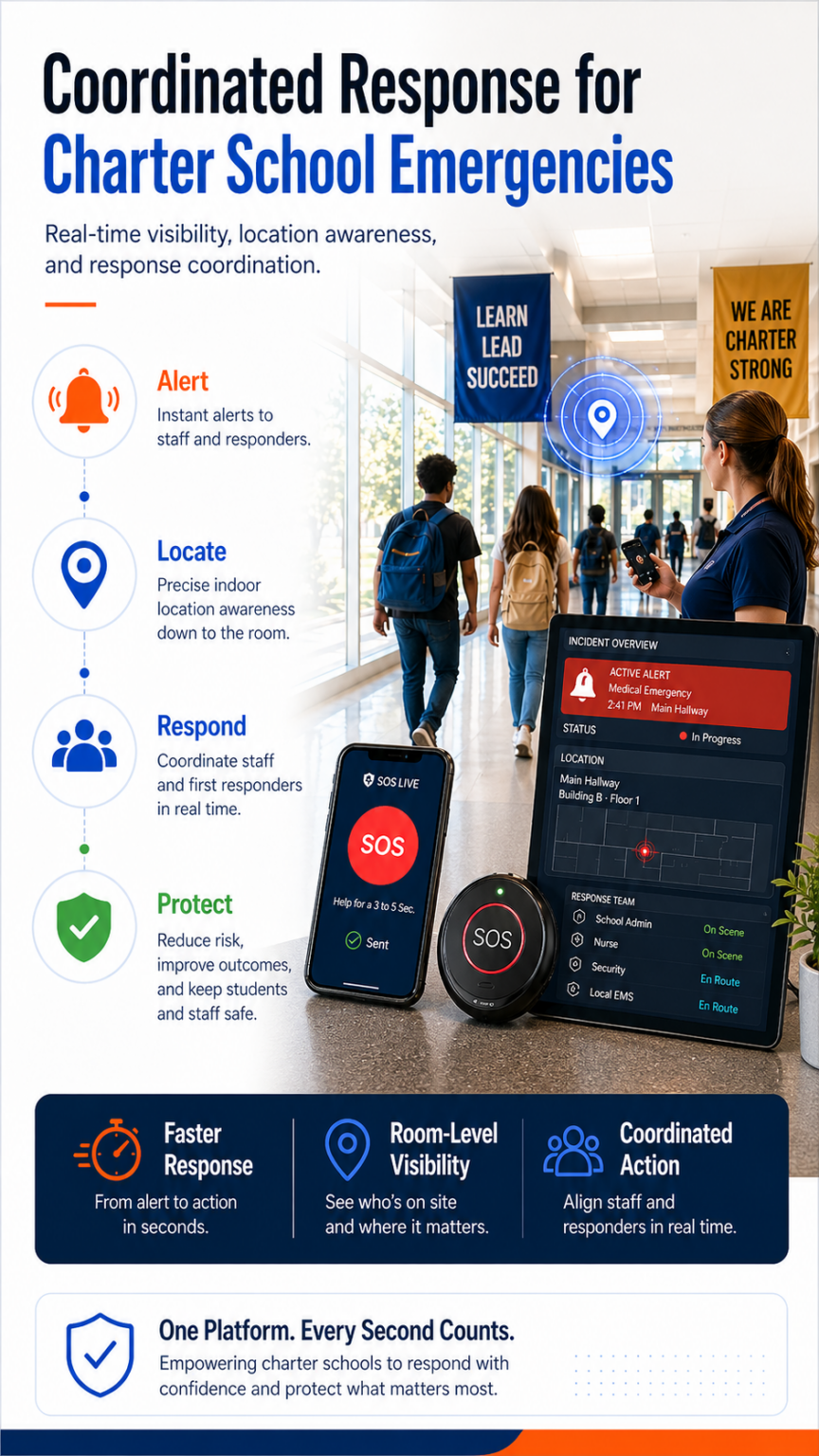
When an SOS alert is activated, the platform can immediately send critical information to the appropriate emergency response path. This may include the school location, the type of alert, the device that was activated, and precise location details inside the building.
That information helps reduce confusion and gives responders a clearer picture before they arrive.
For school leaders, the benefit is simple: faster notification, better information, and a more coordinated response.
Built on Proven Public Safety Experience
SOS Technologies is currently supporting large-scale emergency response modernization in New York City schools. The platform was selected after an extensive procurement and evaluation process and is designed to support direct integration with public safety systems.
That experience matters for charter schools.
It means SOS is not a basic panic button system. It is a public safety platform built for real operational environments, complex school facilities, and the urgency of emergency response.
More Than a Panic Button
A panic button is only useful if it leads to action.
SOS combines emergency activation, resilient connectivity, location intelligence, device monitoring, and response coordination into one platform. School teams can know that devices are online, batteries are monitored, alerts are routed properly, and responders receive better information when an incident occurs.
This helps charter schools move beyond compliance and toward a more complete safety strategy.
Key Benefits for Charter Schools
Faster Emergency Response
Reduce the time between activation and responder notification from minutes to seconds.
Precise Location Awareness
Help identify where an alert originated, including location within the building.
Reliable Connectivity
Use redundant network paths to help ensure alerts get out when they matter most.
Staff-Friendly Activation
Give teachers and administrators simple ways to request help without leaving students or escalating panic.
Scalable for Charter Networks
Deploy across individual schools, multi-building campuses, or full charter networks.
Public Safety Integration
Support stronger coordination with emergency responders and public safety systems.
Operational Visibility
Monitor devices, connectivity, and system health from a centralized platform.
Better Information
Give responders clearer incident details before they arrive on scene.
Future-Ready Safety
Build a safety strategy that can evolve with your school, campus, or network.
A Smarter Safety Standard for Charter Schools
Parents, teachers, staff, and students expect schools to be prepared. Charter schools have an opportunity to lead with a modern safety platform that reflects the seriousness of today’s emergency response challenges.
SOS Technologies helps schools act faster, communicate better, and provide first responders with the information they need when seconds matter.
Schedule a Charter School Safety Review
Learn how SOS Technologies can help your charter school or charter network improve emergency response, strengthen campus safety, and create a faster connection between school staff and first responders.