
Activate
The crew member uses a purpose-built LivePoint endpoint or approved mobile workflow.
SOS Live for maritime + complex steel
Connect crew activation, resilient sub-GHz coverage, onboard command, medical and security coordination, deck context, and readiness across vessels and other RF-challenging environments.
The operating challenge
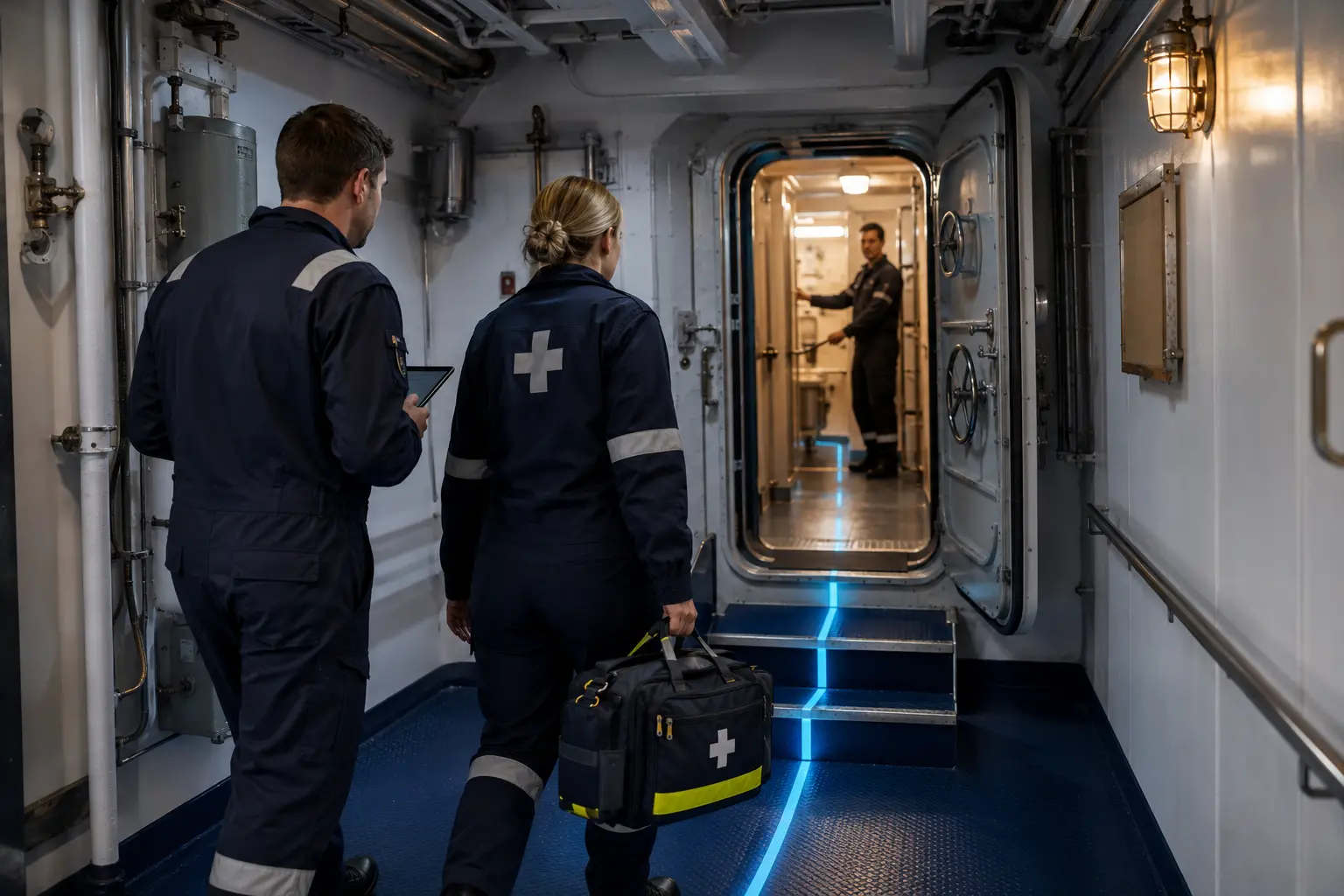
GNSS does not provide useful indoor context below deck, and conventional signals can behave unpredictably around steel. Response teams need semantic location—deck, section, compartment, room, or zone—plus a path that respects real doors, stairs, and bulkheads.
Representative workflow
A crew member activates a wearable inside a covered deck or service area. LiveLocate uses the supported signal environment to identify the best mapped zone, while LiveGrid communicates deck and route context to the onboard response team.
The crew member uses a purpose-built LivePoint endpoint or approved mobile workflow.
The incident receives the best supported deck, section, room, zone, or building-level result.
Trajectory logic uses mapped doors, corridors, stairs, and decks to suppress impossible jumps.
Onboard security, medical, and operations roles acknowledge and coordinate from one incident.
If signal evidence weakens, SOS Live broadens precision instead of showing a false compartment or room.
Connected capabilities
SOS Live modules keep activation, location, response ownership, communication, readiness, and audit connected rather than creating another collection of isolated screens.
Purpose-built wearable and fixed activation endpoints.
Sub-GHz mesh extension, site coordination, buffering, health, and resilient routing.
Semantic deck or zone recognition and responder-ready tactical mapping.
Incident ownership, onboard communication, readiness, reporting, and audit.
How SOS Live 2.0 fits
SOS Live 2.0 connects the full response lifecycle—from activation and policy to coordination, readiness, evidence, and approved escalation. Each capability can be configured around the people, risks, and operating model of this environment.
LivePoint, LiveRelay, and LiveGateway create a resilient sub-GHz signal and site-connectivity layer for decks, compartments, service areas, terminals, and similar structures.
LiveCommand connects crew or passenger identity, event, device state, response ownership, communication, and outcome across onboard roles.
LiveLocate and LiveGrid can provide the best supported vessel, deck, section, compartment, room, zone, and valid-route context.
LiveUnity supports role-appropriate notification, acknowledgement, updates, and safety checks across onboard response teams.
Gateway buffering, node health, self-healing participation, device telemetry, tests, and graceful degradation make failure states visible rather than silent.
Deployment design
A strong design starts with roles, risks, policy, existing systems, and acceptance criteria—not a one-size-fits-all device count.
Build a better response
We’ll review vessel or facility structure, decks, compartments, materials, coverage, onboard roles, escalation, and acceptance scenarios.